
Four buyers held their capex plans, Meta and SpaceX showed how the build is funded, toolmakers guide December higher, and forecasters see AI memory tight into 2027 while slack points to the channel tier.
layer one: the buyers' october prints
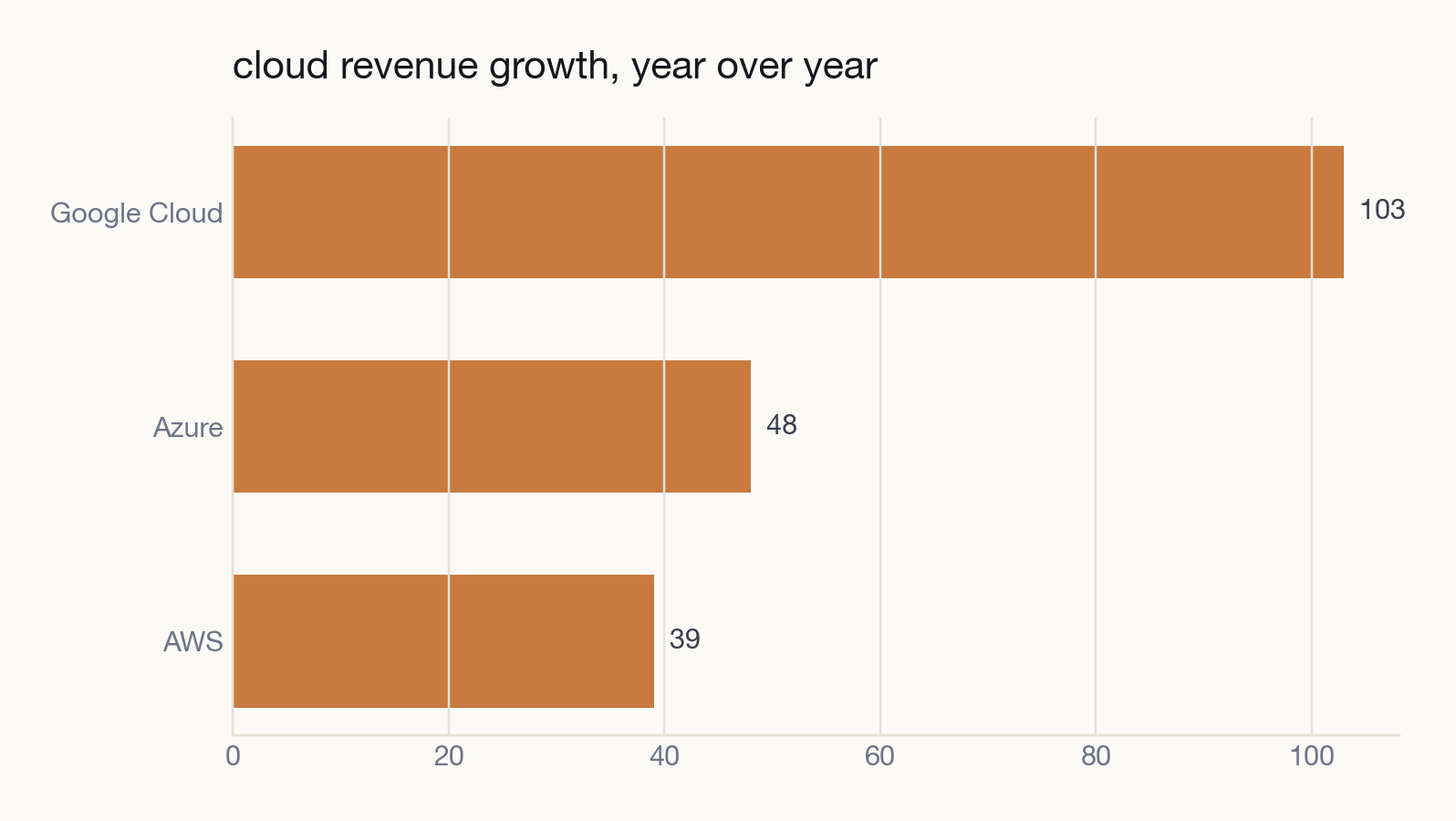
The buyer layer now rests on four October prints, not on carried estimates. Microsoft's capital expenditures were $45.2 billion in the quarter ended , and finance leases were $7.4 billion of that. On its call, Microsoft's finance chief guided second-quarter spend to over $50 billion and calendar-year spend to approximately $170 billion, held back by delayed third-party capacity, and said customer demand continues to exceed available supply. Roughly three quarters of that capex went to short-lived assets, primarily CPUs and GPUs, including higher memory and storage costs, which is the line that ties this layer to the memory layer. Meta's capital expenditures, including principal payments on finance leases, were $34.91 billion, and it anticipates 2026 capital expenditures of $135-145 billion, narrowed from $130-145 billion; looking beyond 2026, it expects to continue investing aggressively. Alphabet's Google Cloud revenue increased 103% to $30.7 billion, and on its call, as reported by CNBC, the company held its 2026 capex range at $195 billion to $205 billion, with its finance chief expecting capex to increase significantly in 2027. Amazon still expects 2026 cash capital expenditures of about $220 billion, with AWS segment sales up 39% to $46.0 billion and AWS revenue growth projected at over 40% in both 2027 and 2028. Four companies, four disclosures, one direction. The forward read for 2027 rests on Alphabet's and Meta's qualitative statements and Amazon's AWS projection, because none of the four gave a 2027 capital spending figure. Full breakdowns: tkal.news/earnings/msft-fy27q1, tkal.news/earnings/googl-q3-26, tkal.news/earnings/amzn-q3-26, tkal.news/earnings/meta-q3-26.
the funding layer: who pays for the build, at what price
Between the buyers and the toolmakers sits the money, and the evidence shows it at three price points. At the top, Meta launched approximately $35 billion of underwritten public offerings and plans an approximately $60 billion at-the-market program. It priced a 6.50% mandatory convertible preferred and upsized its common offering to $25.0 billion, saying its Aa3/AA- credit ratings allow it to raise long-term debt efficiently and that the equity is a complementary source of capital. In the middle, private capital is building a lease market for chips. SpaceX reached a binding commitment for an approximately $40 billion master finance lease for GPUs with an entity managed by Apollo, with anchor commitments from funds managed by BlackRock and Goldman Sachs Asset Management and accounts advised by KKR. Blue Owl reported $330 billion of assets under management and a record institutional capital raising quarter, and IREN closed a $363 million equipment financing with Wingspire Equipment Finance, as reported by ABF Journal. At the neocloud tier the price of money is highest. CoreWeave's delayed draw facility priced at SOFR + 5.50% with ratings of Ba2 and BB+, its existing senior notes carry coupons from 8.500% to 9.750%, and its latest financing, on , was $3.7 billion of 2.875% convertible senior notes due 2033. It describes its at-the-market program as supporting an objective of migrating its credit profile toward investment grade, and it presents a five-year loan against three-year customer contracts as lender confidence. It reports third-quarter results on , after this window. Blackstone's chairman Stephen Schwarzman called AI and energy infrastructure the core investment themes, as reported by the Seoul Economic Daily. The read for the chain: the top tier funds itself through investment-grade balance sheets and equity, private capital is underwriting GPUs as a leasable asset, and the neocloud tier pays the highest stated rates in this evidence. The credit layer's watch item is the cost and term of that highest-priced money as it rolls, an aggregate read rather than a call on any one borrower. Full breakdowns: tkal.news/earnings/meta-q3-26, tkal.news/earnings/crwv-q2-26.
layer two: the tools guide the next quarter up
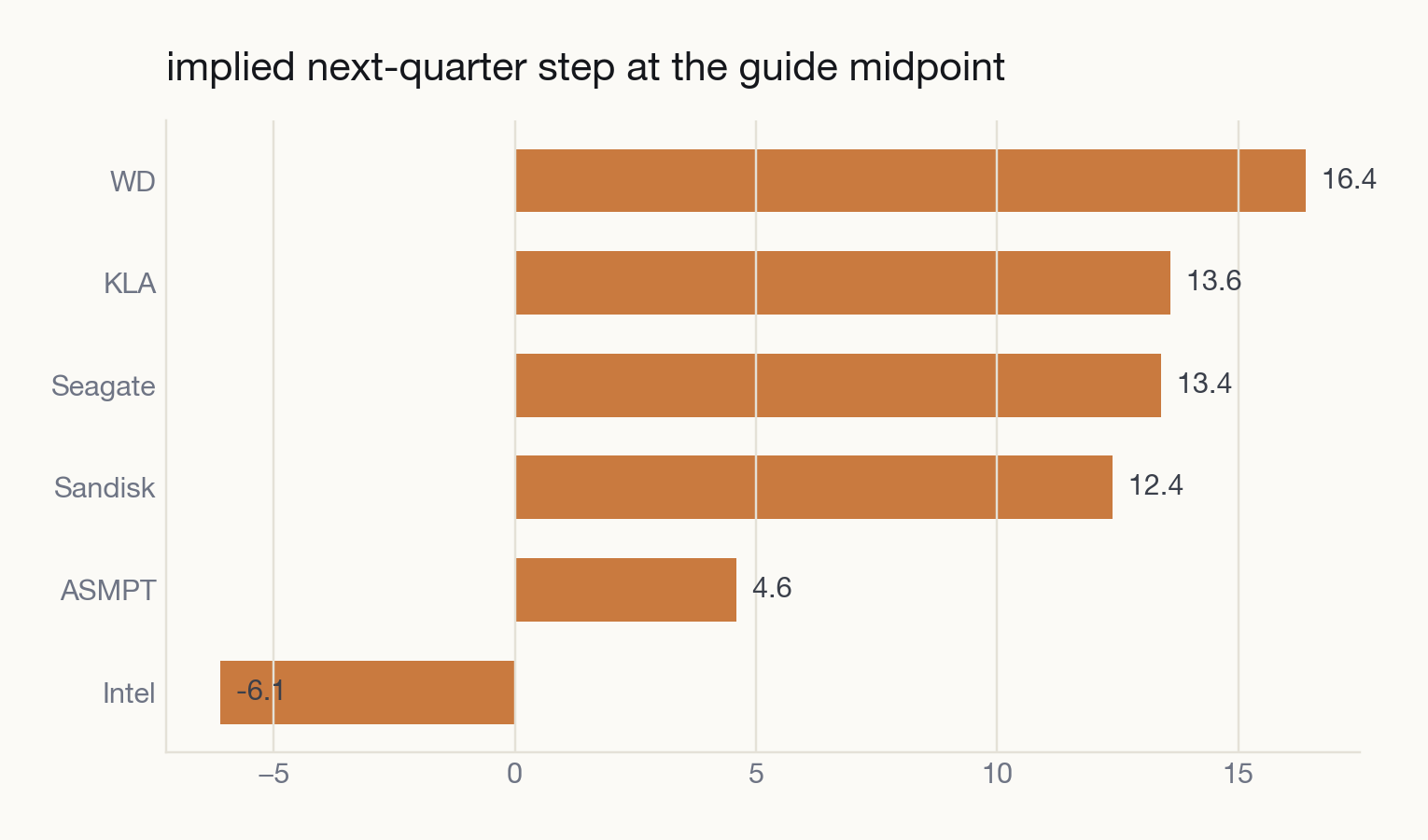
If the buyers' budgets are real, the toolmakers should be guiding up, and they are. KLA reported $4,136 million for the quarter ended and guided December to $4.7 billion, plus or minus $200 million, about 13.6% higher at the midpoint; its chief executive says KLA continues to be critical to the AI ecosystem buildout. ASM guided fourth-quarter revenue to €1,230 million, plus or minus 5%, after a record €1,159 million, and projects 2027 revenue above €5.7 billion at constant currencies. ASMPT booked a record HK$8.85 billion, up 137.9% year over year, with record TCB orders on AI data center demand, and guided fourth-quarter revenue up 4.6% at the midpoint. Advantest raised its full-year net sales and operating income forecasts, and TDK raised its full-year revenue, operating profit and capital spending forecasts. That is corroboration from five companies in different parts of the equipment and component chain, reporting in different currencies and fiscal calendars. The layer is not uniform. ASMPT expects fourth-quarter bookings below its third-quarter record because of one-offs and pull-ins in SMT, so one toolmaker's order book steps down even as its revenue steps up. ASM's 2027 projection is the group's only explicit calendar-2027 revenue figure, so the read beyond the current fiscal years rests mostly on one company. This layer's implication for the next is that memory makers are buying tools to add capacity, which is what SK hynix and Samsung say about their own investment. Full breakdowns: tkal.news/earnings/kla-q1-fy27, tkal.news/earnings/tdk-q2-fy27.
layer three: memory supply is placed before it is built
The memory makers describe the same demand from the supply side. SK hynix reported 104.6155 trillion won of revenue at an 80% operating margin. It says long-term agreements secured to date cover more than half of its 2027 and 2028 capacity, expects demand to exceed supply through 2030, and expects HBM4 to surpass HBM3E in both shipment volume and revenue in the fourth quarter; those are company forecasts. Samsung posted consolidated revenue of 195.3 trillion won, an all-time quarterly high, significantly scaled up HBM4 sales, and expects AI-driven demand in 2027 to far exceed industry supply. It plans 2026 capital expenditure of about 84.4 trillion won. Macronix, a much smaller NOR maker, says high-density NOR demand driven by data centers remains robust, and its third-quarter net sales rose 195% year over year. Two of the largest memory makers and one specialist pointing the same way makes this one of the best-corroborated layers in the issue. The pipeline agrees on direction and holds constructive HBM views at all three large suppliers, each provisional until NVIDIA's results call. It also flags the open question in this layer: whether long-term-agreement coverage reflects consumption or supply-security buying. That question matters because the channel, two layers down, is where the answer would show. SK hynix expects investment to increase significantly next year but plans to adjust its scale and timing flexibly, which is the hinge between this layer and the toolmakers above it. Full breakdowns: tkal.news/earnings/sk-hynix-q3-26, tkal.news/earnings/samsung-q3-26, tkal.news/earnings/macronix-q3-26, tkal.news/earnings/memory-q3-26-wrap.
memory prices: what forecasters project, and what makers guided
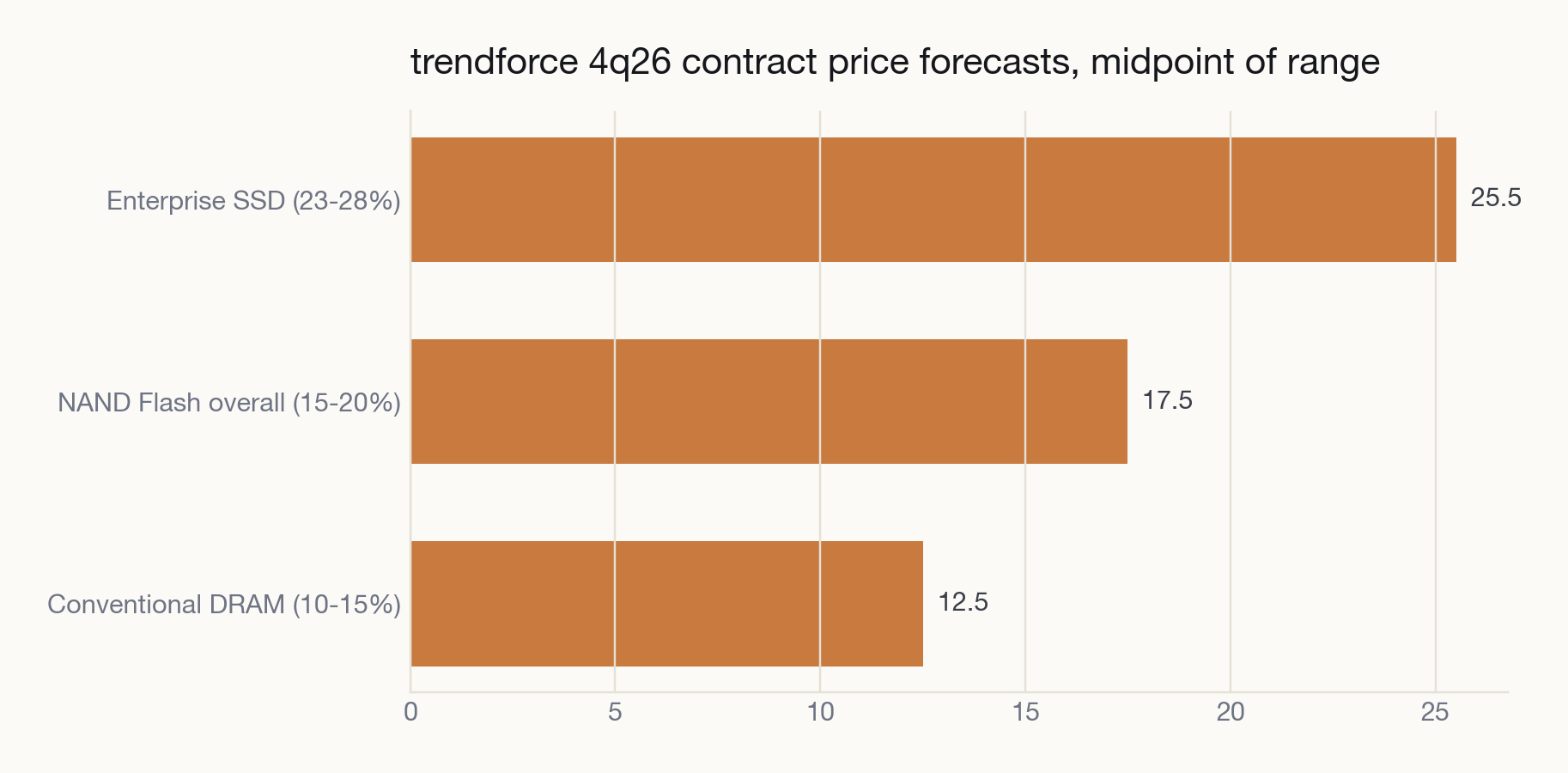
The forecasters' numbers now sit next to the makers' guides. TrendForce's release projects conventional DRAM contract prices to grow 10% to 15% QoQ in 4Q26 and NAND Flash contract prices to increase 15% to 20%, with enterprise SSDs the only category where price growth accelerates. Its research summary dated puts 4Q26 enterprise SSD contract prices up 23% to 28% QoQ. For 2027, TrendForce's release projects HBM blended ASP to jump 121% YoY, and its research summary expects memory spending to pass half of CSP capex next year. Counterpoint's tracker says memory prices are still rising across every segment in Q4 2026, and Omdia's summary expects tight supply and resilient demand to keep NAND undersupplied through 2027 despite moderating price growth. TrendForce's late-October notes show the gains narrowing outside the AI tier: PC DRAM contract prices keep rising but gains are narrowing amid tense negotiations, and fourth-quarter NAND contract hikes are set to narrow as spot prices stay range-bound. Set against the makers, the forecasts agree with SK hynix and Samsung on direction for AI and server memory, and with Kioxia's own note that smartphone and PC demand is trending down. They diverge on the far horizon. In an talk reported by BigGo, Counterpoint's Kang Kyung-soo said he expects prices to return to stability starting in the fourth quarter and through next year, and flagged the possibility of a 20% to 30% decline in DRAM and NAND prices once 2028 arrives, while SK hynix expects demand to exceed supply through 2030. All of these are third-party forecasts, dated as given.
layer three, storage: the guides step up, with one exception
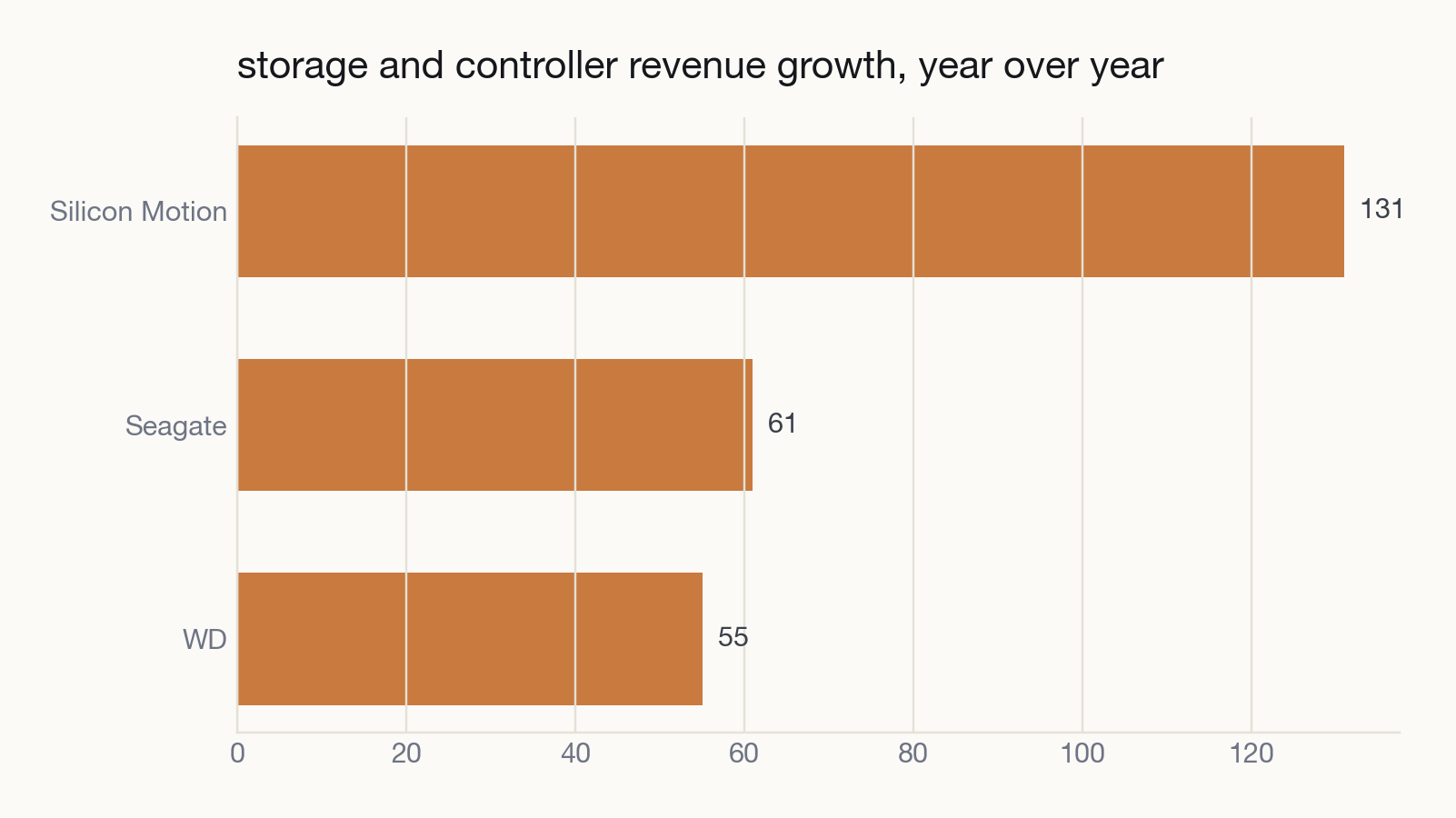
Storage tells the same story in harder numbers, because most of these companies guide in dollars. Sandisk guided the December quarter to $12.2 billion to $12.6 billion after $11.0 billion and says robust and growing demand is driving outpaced growth in its data center business. WD reported revenue of $4.38 billion, up 55%, and guided $5.1 billion, about 16% higher, or 66% to 72% above a year earlier. Seagate reported revenue of $4.2 billion with data center revenue of $3.4 billion, up 63%, guided $4.8 billion, plus or minus $100 million, and says the vast majority of its data center nearline supply is allocated through calendar 2028. Silicon Motion, whose SSD controller sales rose 55% to 60% year over year, reported net sales of $560.2 million, up 131%, and guided fourth-quarter revenue up 5% to 10% sequentially. WD's step is the steepest of the storage guides. Kioxia is the exception the thesis has to explain. Its own October to December outlook is close to the September quarter, citing factors such as the negative impact of exchange rates while expecting data center demand to remain strong. In its review of the six months to September, it also says demand from smartphone and PC customers is seeing a downward trend while demand for AI servers at data centers and enterprise customers is increasing, which is the consumer tier showing through in a NAND maker's own account. The thesis reads Kioxia's flat outlook mainly as a currency effect on a strong quarter rather than a crack in the layer, and that reading is testable: if the exchange-rate drag passes and the outlook still does not step up, the layer is weaker than the dollar guides suggest. Full breakdowns: tkal.news/earnings/sandisk-q1-fy27, tkal.news/earnings/wdc-q1-fy27, tkal.news/earnings/seagate-q1-fy27, tkal.news/earnings/simo-q3-26, tkal.news/earnings/kioxia-q2-fy26.
distribution: AI hardware moves through at thinner margins
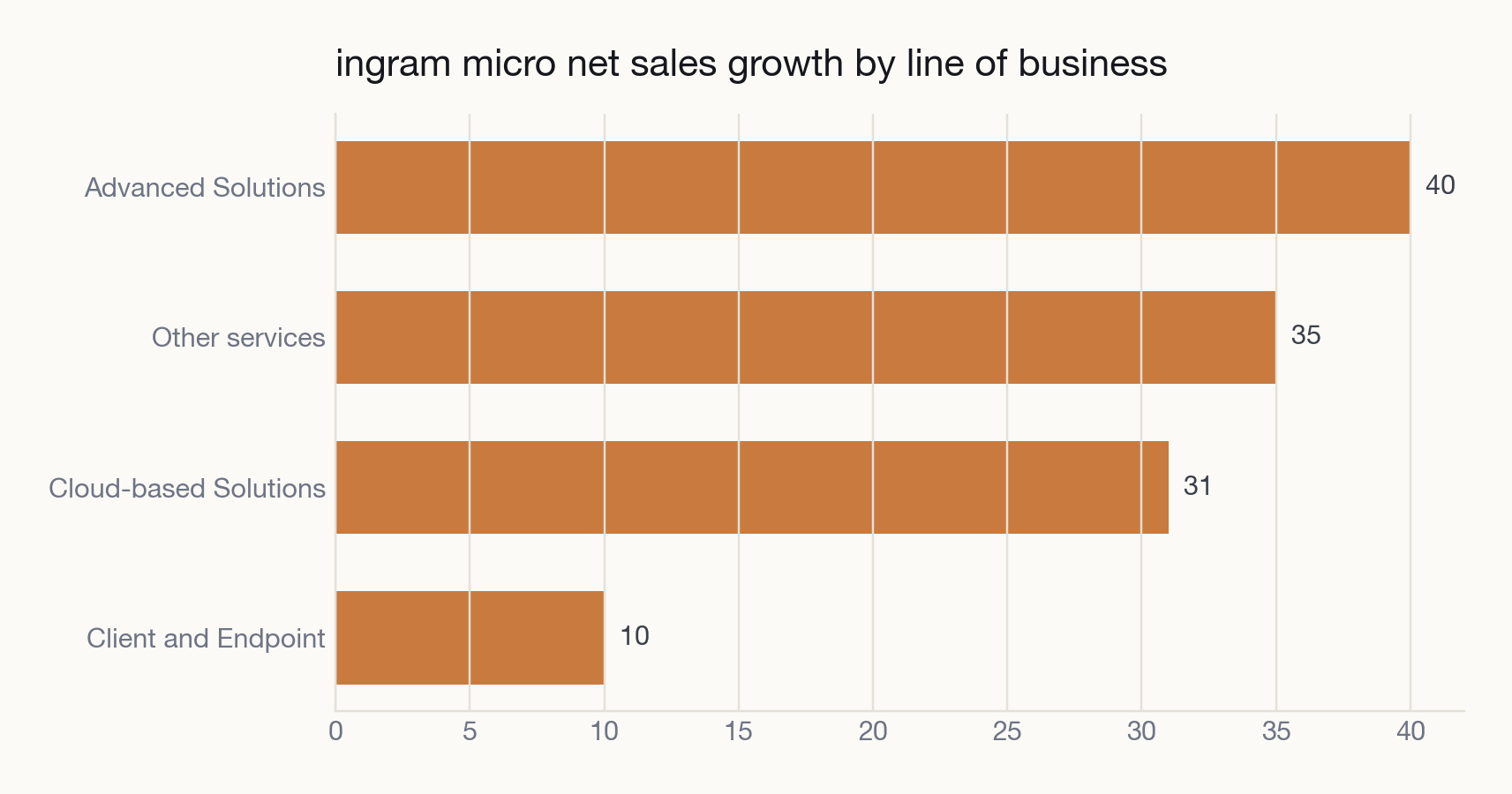
Between the supply makers and end customers sits distribution, and Ingram Micro is the large broadline distributor that reported inside the window. Its net sales for the period ended were $15.2 billion, compared to $12.6 billion, up 20.8%, and it exceeded the high end of its guidance on all financial metrics. Globally its Advanced Solutions offerings, which include GPU and AI infrastructure as well as networking and servers, increased by 40%, four times the 10% growth of Client and Endpoint Solutions. In North America, net sales rose 31.5% on a 61% increase in Advanced Solutions. It guided fourth-quarter net sales to $17.5 billion to $17.9 billion, a year-over-year increase of 17.6% to 20.3% and about 15% to 18% above the third quarter; that is a company forecast, and the fourth quarter has fourteen weeks against thirteen a year earlier, and the extra week flatters both comparisons. That corroborates the upper layers from a different seat: AI infrastructure is now large enough to move a broadline distributor's mix. It also shows the cost. Gross margin was 6.55%, compared with 6.90% a year earlier, which Ingram attributes to lower-margin, low cost-to-serve GPU and AI-infrastructure products; excluding those large deals, gross margin was 7.06%, roughly flat with 7.10%. It says high sales growth requires investment in net working capital, particularly inventory and accounts receivable, which it has financed largely through vendor payment terms. For the chain, distribution is where the AI build shows up as mix, margin and working capital inside one income statement. The next distribution reads, Avnet's September-quarter results and Taiwan distributors' October revenue, are on the pipeline's list of upcoming catalysts. Full breakdown: tkal.news/earnings/ingram-micro-q3-26.
where the companies disagree, and what it means
A thesis built from agreement has to show where the evidence does not agree. There are five places. First, Intel. Third-quarter revenue of $16.5 billion rose 21% and Data Center and AI revenue rose 78%, but the fourth-quarter guide of $15.0 billion to $16.0 billion is 3% to 9% lower. Intel cites near-term PC industry headwinds and sees the PC slowdown continuing at least through the first half of next year, while its immediate priority is unlocking supply for Xeon. That is PC-industry weakness showing up in a company that also serves the AI layer, while Intel itself says demand for its CPUs remains robust and supply is the near-term constraint. Second, Kioxia's flat outlook against the dollar storage guides, which Kioxia ties to factors such as exchange rates and the thesis reads mainly as currency rather than demand. Third, ASMPT's bookings, guided below the third-quarter record on SMT one-offs while its revenue guide rises. Fourth, SK hynix's own caveat that it will adjust the scale and timing of investment flexibly even as it expects investment to increase significantly. Fifth, Ingram Micro, where AI hardware lifts sales but lowers gross margin and growth needs more inventory and receivables. Three more sit in the forecasts and the credit data. Counterpoint's Kang expects prices to stabilize from the fourth quarter and flagged a possible decline in 2028, while SK hynix expects demand to exceed supply through 2030. TrendForce's note says some CSPs face cash flow constraints, with high-capacity modules redirected to other CSPs and OEMs, even as the four buyers' October prints keep their 2026 capex plans in place. And Blue Owl reported a record institutional capital raising quarter while its direct lending net deployment was negative $0.3 billion. None of these breaks the chain on this evidence, but each marks where it would break first: PC demand for Intel, currency in the NAND tier for Kioxia, equipment orders for ASMPT, memory capital spending for SK hynix and working capital in distribution for Ingram. Full breakdowns: tkal.news/earnings/intel-q3-26, tkal.news/earnings/kioxia-q2-fy26.
layer four: the channel is the release valve
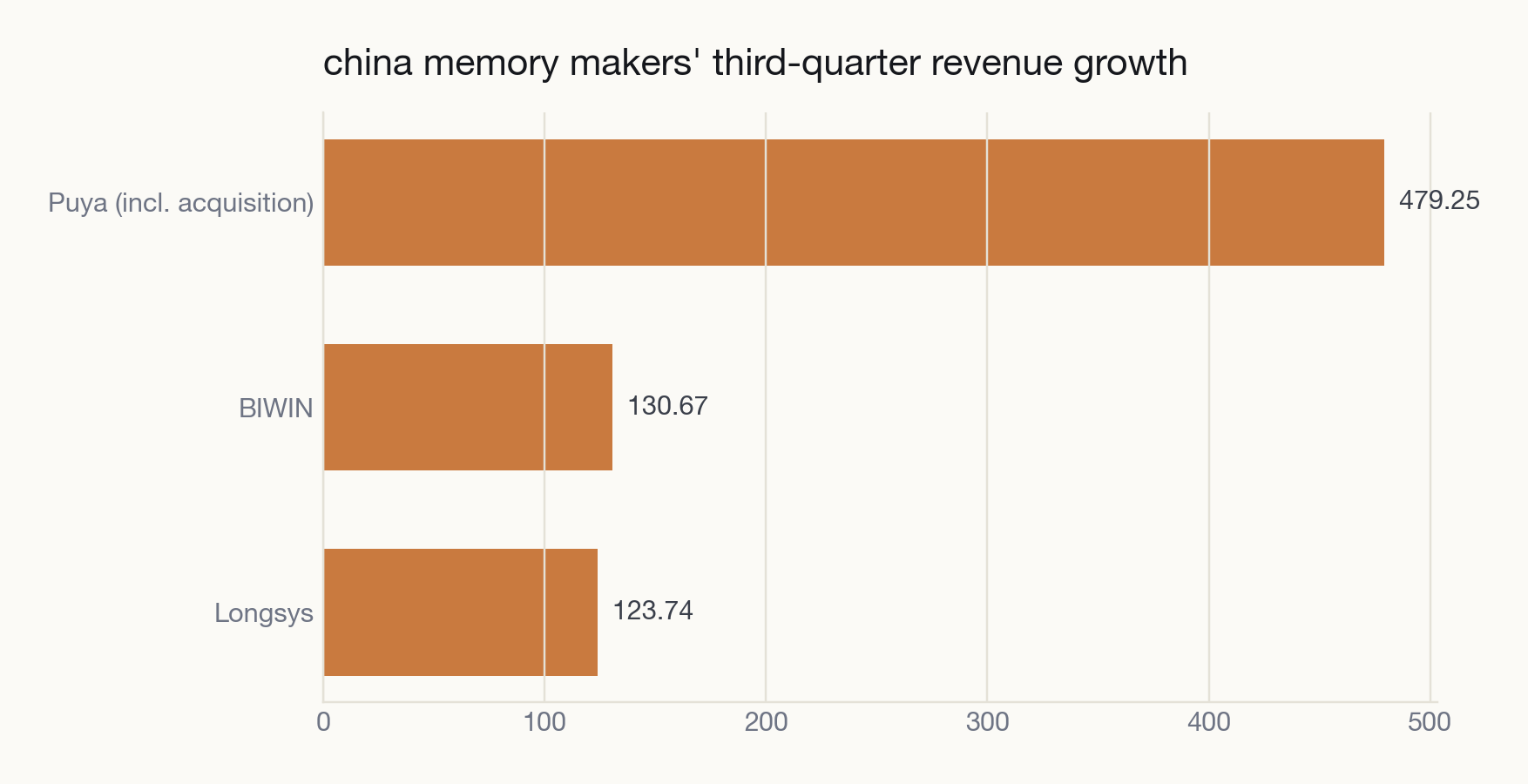
If the chain loosens, the pipeline expects the channel and consumer tier to move first. It places the demand cycle at reversal for client DRAM, mobile and channel NAND and has accepted consumer demand destruction. It describes channel NAND as liquidating, keeps its procurement book unchanged on channel TLC and steps back only from China-channel 128GB QLC. The China memory makers' own numbers do not show that yet. Longsys third-quarter revenue rose 123.74% year over year and BIWIN's rose 130.67%. BIWIN attributes its year-to-date growth to the AI compute boom and a memory upcycle. Longsys describes the industry shifting from a consumer cycle to an AI-driven technology cycle. Puya's third-quarter revenue rose 479.25%, but an acquisition consolidated in contributed about 2.039 billion yuan of a 2.524 billion yuan year-over-year increase, so its organic growth is far smaller than the headline. TrendForce's late-October data shows the valve starting to move: its note says sellers have turned more aggressive in dumping, sending wafer spot prices sharply lower. An TrendForce note also expects revenue and margins at consumer-focused module makers may decline, an aggregate view rather than a read on any one company. This is the deepest disagreement in the issue: the model says the channel is weakening while the companies that sell into it just reported large year-over-year gains. The thesis handles it by keeping the caution on the lane rather than on any company, and by watching the channel as the place where slack in the upper layers would surface first. Full breakdowns: tkal.news/earnings/longsys-q3-26, tkal.news/earnings/biwin-q3-26, tkal.news/earnings/puya-q3-26.
the linchpin, what would break the chain, and the call
Put the layers together and the joint that matters most is where the buyers' budgets turn into accelerators that carry the memory the third layer has placed forward. That joint is NVIDIA, and it reports after this window. On NVIDIA reported second-quarter revenue of $96.2 billion against its own outlook of $91.0 billion, plus or minus 2%, and Data Center revenue of $89.0 billion, up 117%. For the third quarter it guided $108.0 billion, plus or minus 2%, assuming no Data Center compute revenue from China, and it will discuss those results on . The pipeline already treats that call as the test of every constructive HBM view it holds. KLA remains the cleanest instrument inside the window for the toolmaker layer, but as a process control maker it is a partial read on memory capacity additions rather than a pure one, which is why the call sits on NVIDIA. Three things would break the chain over the next two quarters, in the order they would show: consumer and channel demand weakening further; memory makers using the flexibility SK hynix describes to slow 2027 spending; and the buyers' backlog growth slowing. Only the first shows in this window's releases, through Intel's PC-industry headwinds and Kioxia's note that smartphone and PC demand is trending down; the other two do not. The data limits that bound this read are at the end of the issue. Full breakdown: tkal.news/earnings/nvda-q2-fy27.
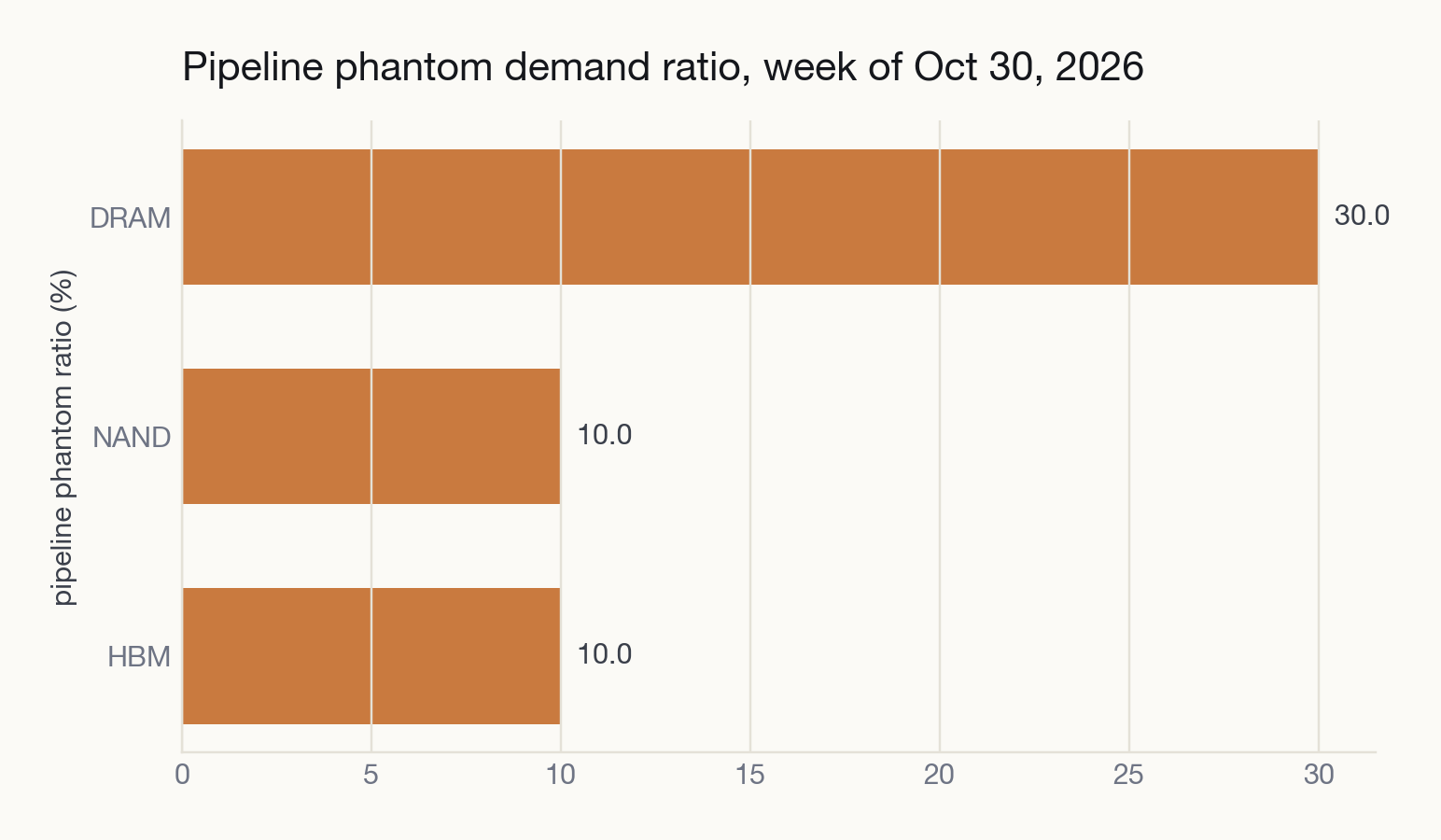
| Segment | State | Tape | Phantom % |
|---|---|---|---|
| DRAM | Firm | UP · Slight | 30% |
| NAND | Softening | DN · Slight | 10% |
| HBM | Tightening | UNCLEAR · Slight | 10% |