From the editor
tkal is a daily synthesis of the credit, demand, and capex cascades I've been running for myself. Receipts published weekly: every dated call gets graded, blindly, against what actually happened. The premise is that most market writing is unfalsifiable by design — vague enough to be re-narrated after the fact. This is the opposite. The conviction level is on the call. The horizon is on the call. The falsifier — the thing that would prove it wrong — is on the call. If the call misses, it's in the scorecard. If it hits, also in the scorecard. The newsletter is what the model saw this week; the scorecard is whether the model has been right. Not investment advice. Positions may exist in the names discussed.
The Read
The book went defensive this week: 2027 HBM4 is the only buy left, provisional and low conviction, while consumer memory softens and credit offers no tie-breaker.
one provisional buy, a defensive book
Watch · the week in 3 minutes
01 · Signal
hbm4 is the last buy standing, on thin support
Most 2027 HBM is reportedly contracted at higher prices, and AMD says it will substantially increase 2027 accelerator supply and is working with memory makers to secure memory. SK hynix is broadening HBM4 and DDR5 supply to AMD. Samsung's 12-layer HBM4E reportedly won NVIDIA validation, per a paywalled excerpt. No 2027 price is signed. The buy rests on one tracker plus one customer statement, and the 8-high versus 12-layer Rubin stack height is still contested.
One buy survives, on one tracker and one customer's word. The end-October settlements decide whether it holds.
02 · Signal
consumer memory softens at today's prices
DDR4 is called ample, Huaqiangbei merchants report fewer discretionary upgrades, and TrendForce warns that memory and SSD costs threaten 2027 notebook demand. Channel TLC loosened for a second week. Unconfirmed relays add a mobile leg: Samsung Mobile reportedly asked suppliers for up to 30% lower Q4 smartphone volumes, and Apple reportedly seeks at least 15% lower iPhone 18 Pro component orders. The demand pipeline reads destruction as forming, moderate in severity and low in confidence. Server DDR5 is still scarce at brokers.
The AI leg still points up. The consumer leg is the one under test, and the handset cuts are not confirmed.
03 · Signal
credit offers no tie-breaker on a degraded week
Credit reads STABLE only by default: none of the week's 20 financing events could be verified, confidence is LOW, and there is no lead-lag clock. Five lenders sit on WATCH, all on unverified Tier-2 reports, including a record Oracle 5Y CDS excerpt. The collection itself was thin, with 5 of 7 nights, two recovery-only days and an Oct 11 web outage. Of 142 supply L1 records, 135 are still pending QA, and 9 of 16 demand segments are unavailable.
This week's gaps mean unchecked, not quiet. The first credit signal is the GPU-cloud loan, commitments due Oct 14.
The Call · HBM4 Holds, Provisionally
The book is defensive and its only buy is 2027 HBM4 allocation, provisional and low conviction. Settlements due around either confirm it or fire the reversal.
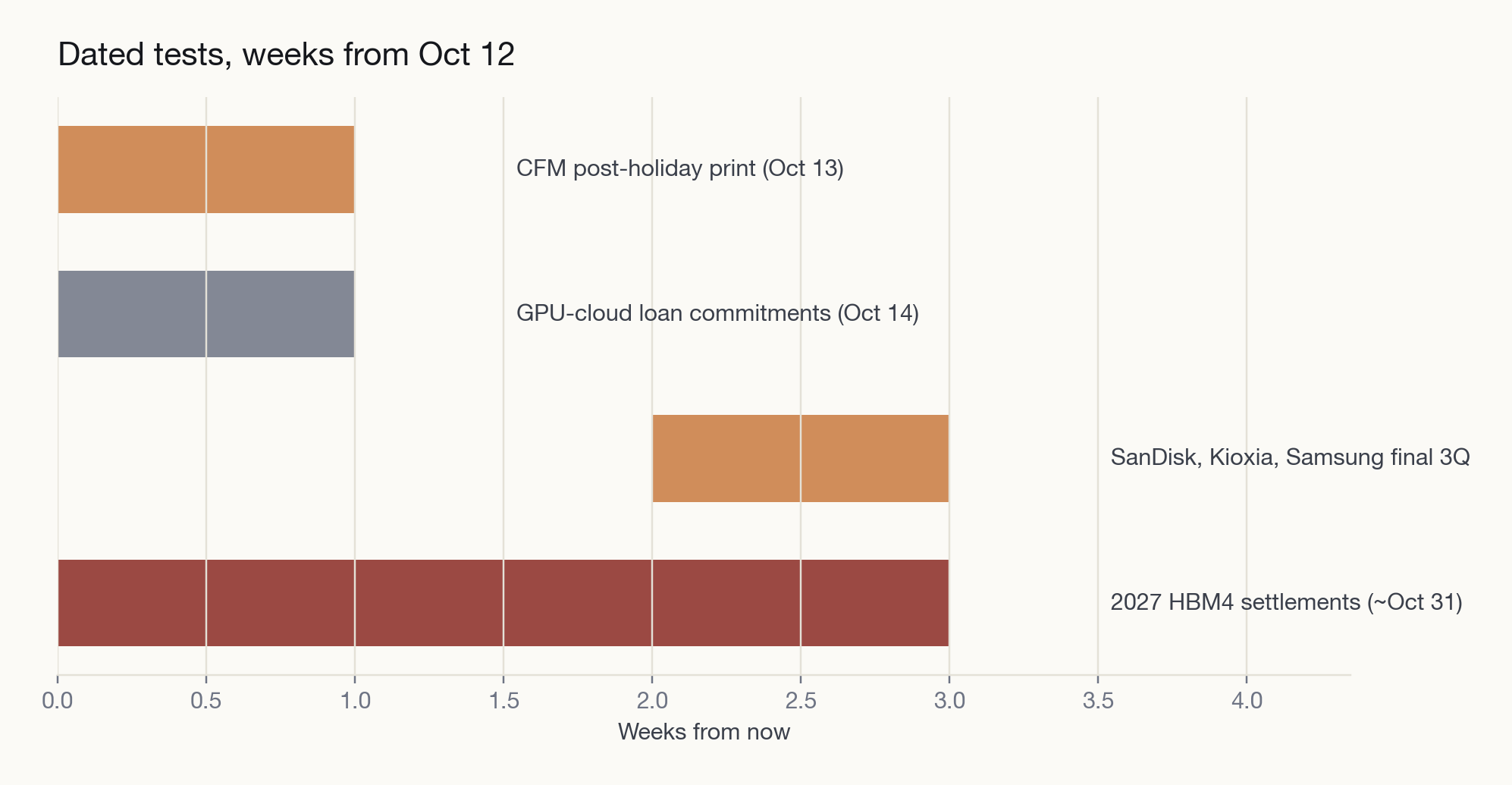
At the CFM price update. Treat it as the first real post-holiday test of consumer demand. A week-over-week drop in DDR5 die, flash wafer or client SSD prices confirms the softening; a hold leaves it unproven. TrendForce showed DRAM spot sideways in a holiday and month-end week, and CFM's pages stayed frozen, so last week's test was only half run. Nanya's reported contract notices of up to 20% sit against flat DDR4 spot.
§
By the 2027 HBM4 settlements, around . Read SK hynix, Samsung and Micron through signed prices, not asking quotes. Settlements well below asking, or 8-high as the main Rubin stack, break the only buy. Micron settled all Netlist litigation with a five-year license, removing the ITC exclusion risk to its HBM and server DIMMs. The end-October DRAM contract print tests the reported +10-15% and up-to-20% notices in the same window.
§
Across the -30 prints. SanDisk and Kioxia decide whether enterprise SSD tightness holds. Samsung's final 3Q results can confirm or deny the reported 15-30% handset cuts. Kioxia's LD4 QLC data-center SSD is sampling with hyperscale customers, not in volume. The eSSD read rests on one publisher and has no TLC/QLC split, so it reaches no instrument yet.