From the editor
tkal is a daily synthesis of the credit, demand, and capex cascades I've been running for myself. Receipts published weekly: every dated call gets graded, blindly, against what actually happened. The premise is that most market writing is unfalsifiable by design — vague enough to be re-narrated after the fact. This is the opposite. The conviction level is on the call. The horizon is on the call. The falsifier — the thing that would prove it wrong — is on the call. If the call misses, it's in the scorecard. If it hits, also in the scorecard. The newsletter is what the model saw this week; the scorecard is whether the model has been right. Not investment advice. Positions may exist in the names discussed.
Corrected ·
This issue was first published from a single night of evidence collection. The pipeline moved to nightly collection, and each nightly file carries only what is new since the last run, so reading the newest file alone read one night as though it were the week. Four items, not fifty-nine. The original call, that the engine stood down for want of anchor data, was wrong. The anchor data existed and was not read. The week has been re-run against the full window and the issue below is rebuilt from it. What changed, and what it cost, is in the closing note.
The Read
The 2027 book closed while nobody was looking, and what it leaves behind is two markets: one hard-allocated through next year, one breaking on price.
five decisions, and the split is now the structure
Watch · the week in 3 minutes
01 · Signal
the 2027 book is closed
The hardest number this week is an allocation figure, not a price. Buyers of 2027 DRAM and HBM capacity are being filled at 60 to 70% of what they ask for, and they are paying deposits up front to get that much. Adata's chairman put HBM and AI servers at roughly 70% of total DRAM capacity. TrendForce has HBM bit shipments growing 50 to 60% next year and still landing short of demand. A supply curve that is sold out a year ahead stops behaving like a cycle. It behaves like a queue.
Enterprise storage is where it shows up in money. Top-five NAND brand revenue rose 77% in a single quarter and Micron moved to third place, which is a share reshuffle happening inside a price surge rather than because of one.
Sold out is a price signal that never shows up on a price sheet.
02 · Signal
one upcycle, two markets
The bifurcation stopped being a split in the data and became a split in the order book. Server CPU units are up 20% year over year and industrial storage suppliers are posting records, with Transcend's first-half revenue up 422%. The consumer lane is contracting in every geography that reports: PC units down 4.9%, smartphones down somewhere between 6.7 and 11% depending on whose tracker you take, India down 11.1% with the second half guided down more than 15%. US console units fell 39%. Desktop CPU units fell 20%. The same shortage is a tailwind on one side of the ledger and a tax on the other.
What makes it structural is where the bits went. Roughly 70% of capacity is committed to AI, and the client market buys the residual. Client contract gains are already narrowing to 13 to 18% a quarter on OEM cost tolerance, and Dell has told commercial customers it cannot lock quotes.
A blended DRAM number now averages two markets that have stopped trading against each other.
03 · Signal
the packaging bottleneck moved countries
The constraint on HBM is not only wafers now. Korean export data shows HBM shipments to Malaysia near $1.3bn while shipments to Taiwan fell below $3bn from over $5bn a few months earlier, and TSMC is reported to have moved part of its advanced packaging to Intel's Malaysia complex as CoWoS runs behind AI-chip demand. CoWoS is scaling hard on its own account, toward roughly 130 to 140 thousand wafers a month by late this year at yields above 98%, and it is reported fully booked against 2026 demand regardless. Neither company has confirmed the arrangement. The export flows are the evidence, and they are not ambiguous about direction.
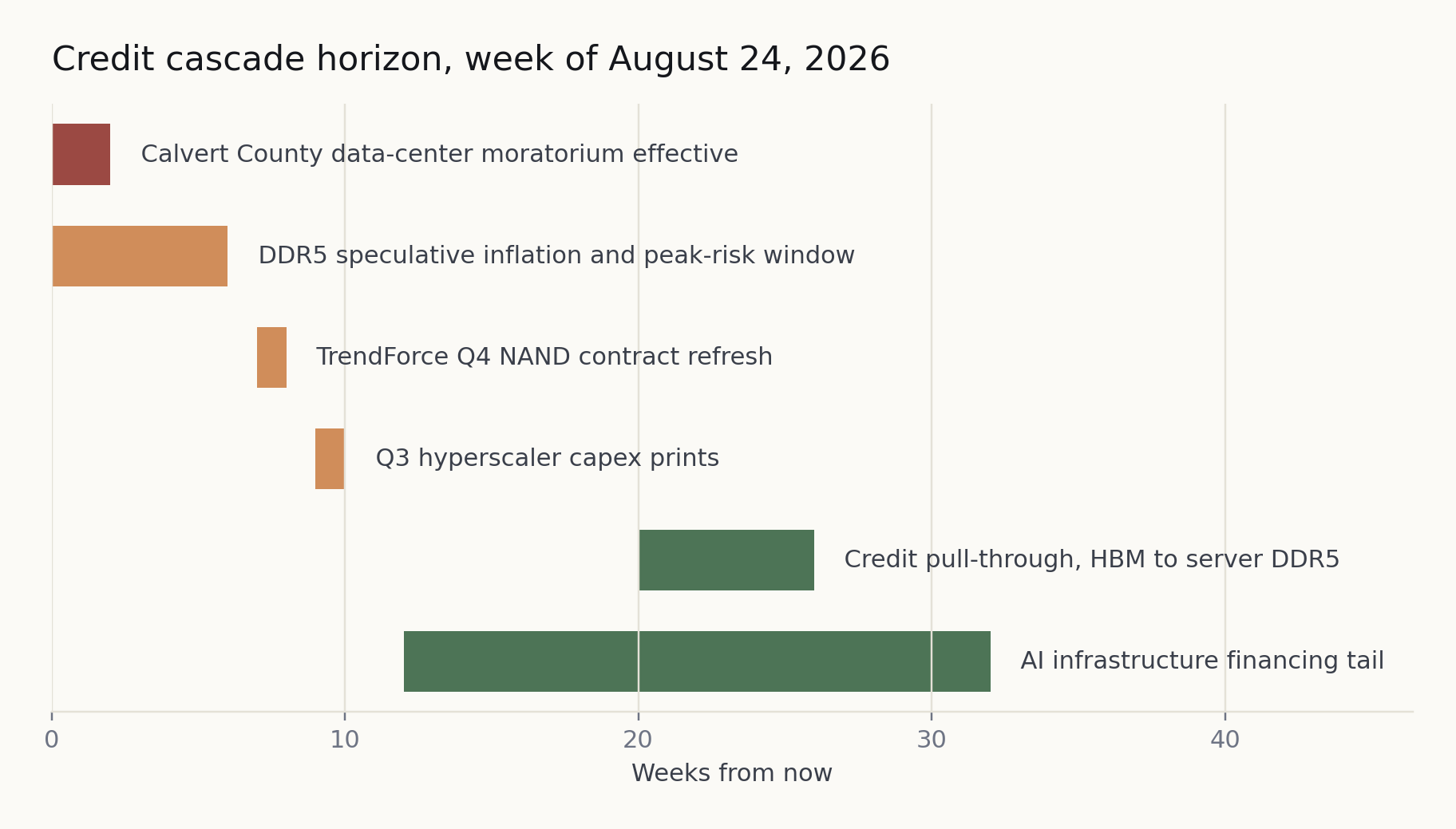
Credit reads stable underneath it, and the disclosed numbers arrived this week rather than last: a $1.3bn private credit facility for an Anthropic-linked Texas site, and $800m for Flexential across four markets. That is the first disclosed principal in this series. It leads memory demand by about 20 weeks, which puts it in 2027.
When a bottleneck changes address, the constraint is real and the relief is on somebody else’s capex line.
The Call · Two Markets, Not One Cycle
Client DRAM contract price gains keep decelerating while server and HBM allocation stays oversubscribed, so the two lanes diverge rather than converge. By . Wrong if Q4 client DRAM contract gains print at or above the Q3 13 to 18% band, or if 2027 server allocation fill rates rise above 80%.
Before the 2027 allocation books close, reported around end of August. HBM and enterprise storage are the two lanes where the constraint is contractual rather than cyclical. Lead-time cover is the exposure that matters, not price. 2027 capacity is filling at 60 to 70% of requested volume against upfront deposits, and CoWoS is reported fully booked against 2026 demand. SK hynix, Micron, Samsung, Kioxia and SanDisk carry this read.
§
Through the fourth quarter, on the client contract print. Server and client DRAM have split. Treating DRAM as one exposure is the error the blended number invites. Client contract gains are narrowing to 13 to 18% a quarter while server and HBM stay hard-allocated. Dell will not lock commercial quotes and Lenovo, HP, Acer and ASUS are resetting list prices 15 to 20%. Client-weighted exposure carries the risk.
§
Now, on the module channel. The one place this week's evidence cuts against the bull read. Distributor stock is building on borrowed money, which is what the top of a memory cycle looks like from the inside. Apacer's inventory hit a record NT$12.4bn, up 48% in a quarter, funded by a NT$4bn five-year syndicated loan raised to buy chips. The pipeline's own inventory trigger fired on it. Module and industrial channel exposure carries this.
What the correction cost
The original issue read four evidence items and reported that no tier-0 or tier-1 anchor existed in the window. The window held eighteen tier-1 items and three tier-0. Three published claims did not survive the re-run: that the weekly contract table had been silent about seven weeks, when TrendForce published a Q3 client DRAM contract read inside the window; that one lender sat in a stressed posture, which the credit layer has since withdrawn as unsupported by its own scores; and that credit was quiet, when $2.1bn of disclosed facilities had priced. The engine went from zero decisions to five. The error was not in the reasoning. It was that the reasoning ran on a delta and treated it as a week, and the pipeline has been changed so that a night that does not collect is now reported as a night that did not collect, rather than as a market that went quiet.