From the editor
tkal is a daily synthesis of the credit, demand, and capex cascades I've been running for myself. Receipts published weekly: every dated call gets graded, blindly, against what actually happened. The premise is that most market writing is unfalsifiable by design — vague enough to be re-narrated after the fact. This is the opposite. The conviction level is on the call. The horizon is on the call. The falsifier — the thing that would prove it wrong — is on the call. If the call misses, it's in the scorecard. If it hits, also in the scorecard. The newsletter is what the model saw this week; the scorecard is whether the model has been right. Not investment advice. Positions may exist in the names discussed.
The Read
q2 earnings printed the deficit into the record, hynix at a 76% operating margin and samsung memory up 357%. the two demand lanes have now split cleanly.
deficit confirmed, the demand lanes diverge
Watch · the week in 3 minutes
01 · Signal
q2 prints put the deficit on the record
sk hynix closed q2 at a 76% operating margin and samsung's device solutions unit rose 357% year over year, the tier-0 realized-earnings validator the deficit thesis had been waiting on. dram average selling prices rose 30% quarter over quarter at hynix. these are booked results, not guidance, and they lift the deficit and pricing beliefs to high conviction.
these are settled numbers, not forecasts. the deficit is no longer a call.
02 · Signal
hbm4 begins mass production, cy26 is spoken for
sk hynix formally started hbm4 mass production at hbm3e-level yields, and high-bandwidth memory is now sold out across all three suppliers for the full calendar year, with backlogs running 52 weeks. samsung's v10 nand is positioned for nvidia's next platform. the ai memory lane has no spare capacity left to sell into 2026, only allocation to ration.
when the whole year is booked, price is set by who gets the wafers.
03 · Signal
the two demand lanes split cleanly
meta raised full-year capital spending to 125 to 145 billion dollars, naming higher component pricing as the reason, and the four us hyperscalers now guide to roughly 725 billion for 2026, up 77% year over year. against that, idc put q2 pc shipments down 4.9% and counterpoint put smartphones down 11%, both citing the memory crunch. one lane funds the deficit, the other absorbs it.
the same shortage filling hyperscaler orders is emptying the consumer shelf.
the call · deceleration, not reversal
trendforce's q3 contract benchmark still points up, dram 13 to 18% and nand 10 to 15% quarter over quarter, but sharply slower than the q1 and q2 spikes. the q4 refresh due around october 15 is the topping validator; a flatline or reversal there would be the first real crack in the pricing thesis.
Segment State · Week of
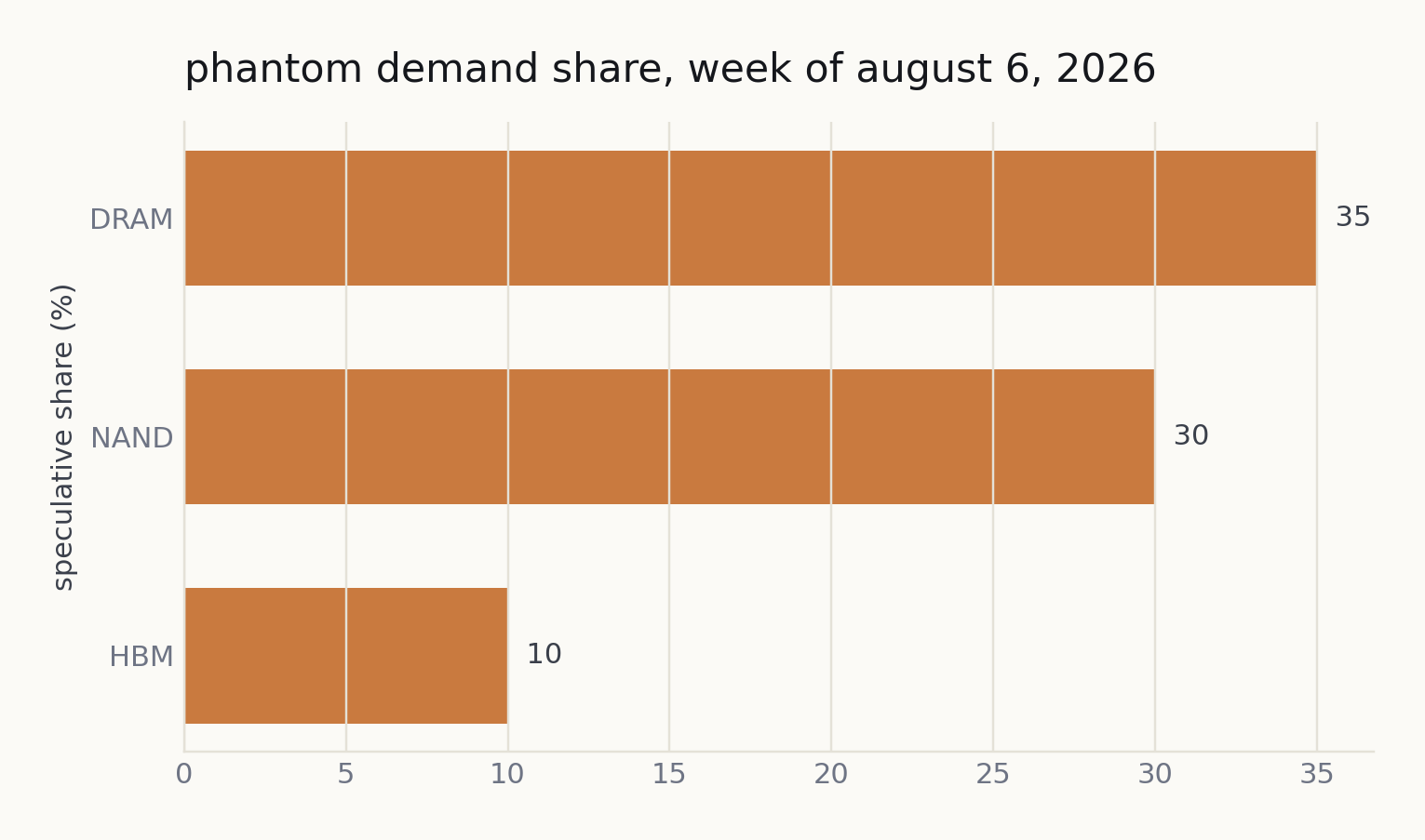
Phantom demand share — at-a-glanceSOURCE · tkal estimate from public shipment, pricing, inventory, earnings & channel data — excludes employer, customer, supplier & other nonpublic information
Segment
State
Tape
Phantom %
DRAM
Tightening
UP · Moderate
35%
NAND
Tight
UP · Strong
30%
HBM
Tight
UP · Strong
10%
What the evidence suggests
§
through the october 15 trendforce q4 refresh. the evidence currently indicates greater pricing durability in hbm and enterprise nand tied to hyperscaler capex than in the commodity client tier. sk hynix, micron and samsung hold the hbm oligopoly through 2027, and cxmt's $8b ipo explicitly does not fund hbm; the segment is sold out for 2026 with 52-week backlogs.
§
before the next pc shipment prints in mid-october. don't read blended dram strength as uniform; server ddr5 is the high-conviction lane while client ddr5 carries a phantom-demand flag. idc pc shipments fell 4.9% and counterpoint smartphones fell 11% in q2, while hyperscaler server ddr5 stays credit-backed through colocation origination (blue owl, equinix $3b).
§
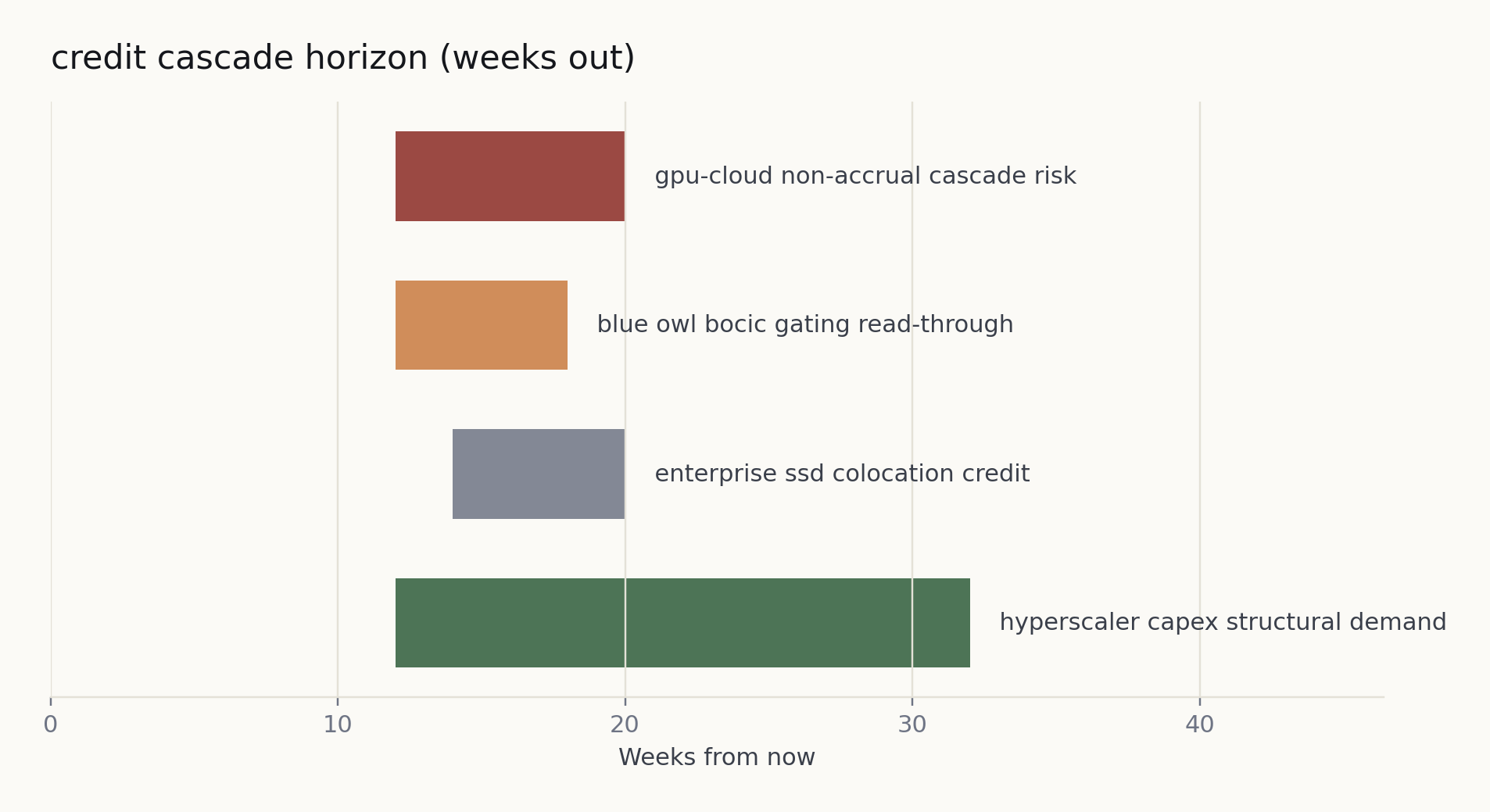
watch apple's august 21 response and the bis cxmt decision near september 30. treat the chinese-substitution and credit-sensitivity stories as unconfirmed tails, not the base case. corsair, hp and dell now ship china-produced ddr5, the first publicly reported western-branded adoption outside enterprise; the 64% credit-sensitive share (anthropic $36b, coreweave $24.9b) sits 12 to 32 weeks out, and blue owl's bocic gated on 18.8% q2 redemptions.