From the editor
tkal is a daily synthesis of the credit, demand, and capex cascades I've been running for myself. Receipts published weekly: every dated call gets graded, blindly, against what actually happened. The premise is that most market writing is unfalsifiable by design — vague enough to be re-narrated after the fact. This is the opposite. The conviction level is on the call. The horizon is on the call. The falsifier — the thing that would prove it wrong — is on the call. If the call misses, it's in the scorecard. If it hits, also in the scorecard. The newsletter is what the model saw this week; the scorecard is whether the model has been right. Not investment advice. Positions may exist in the names discussed.
The Read
The bifurcation stopped being a forecast this week. Contract lanes sold out into 2027 while PC shipments fell 4.9% year over year, the first drop in nine quarters.
contract lane hoards, consumer lane breaks
01 · Signal
the contract lane is sold out, not tight
Phison's CEO said 100% of 2026 NAND production is allocated, with North American cloud providers on multi-quarter agreements running into 2027. Micron confirmed HBM sold out for 2026 and largely pre-committed for 2027. TrendForce guides Tier-1 server DRAM up 13-18% QoQ in 3Q26, landing on non-LTA volumes. Korea's June semiconductor exports printed +199.5% YoY at $44.8B, with HBM up 51% month over month.
Sold out is a different state than tight. It removes the buyer's option to wait.
02 · Signal
the client lane broke, and it printed
IDC put Q2 global PC shipments at 68.2M units, down 4.9% YoY. That is the first decline after nine straight growth quarters. Xiaomi, Oppo and Vivo each cut 2026 targets by 20-30%, naming memory BOM cost. India smartphones fell 4.1%. Meanwhile franchise distributors posted records: WPG +82.9% YoY, Arrow +39%. Each flagged in its own notes that the growth is ASP-inflated, not unit-driven.
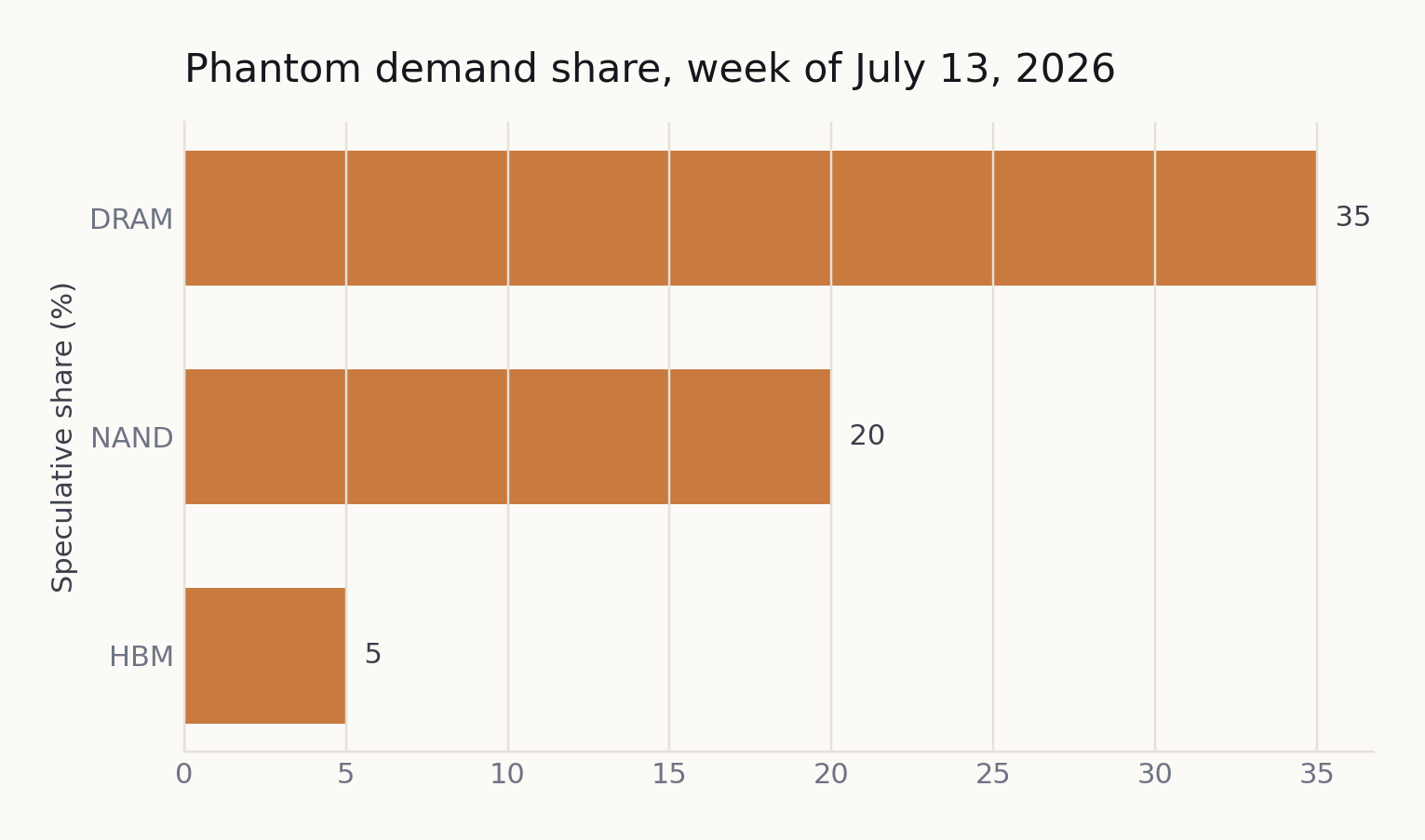
Phantom demand runs 20-40% and it sits almost entirely in the client and mobile lanes.
03 · Signal
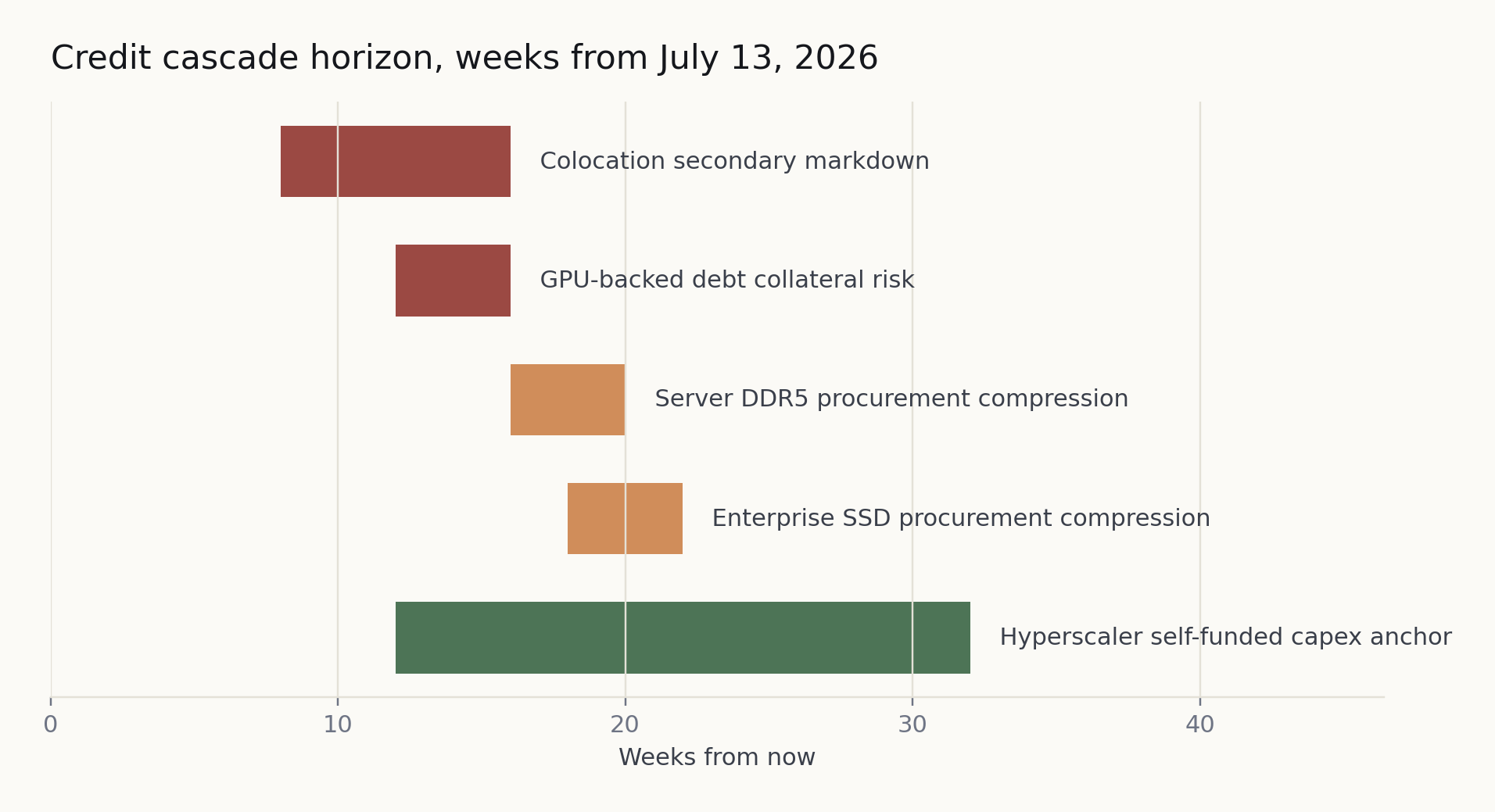
credit moved into the near-term window
The pipeline's near-term credit flag flipped true this week. Colocation secondary markdowns carry an 8-16 week lead, GPU-backed debt collateral risk 12-16 weeks. Both now overlap the channel horizon, which puts September to in play for server DDR5 and enterprise SSD procurement. The structural picture is unchanged: Apollo and Blackstone are expanding, and roughly $725B of self-funded hyperscaler capex still anchors the contract lane.
This is a timing risk sitting on top of a bullish structure, not a reversal of it.
The Call · Meta,
Meta guided 2026 capex to $125-145B and said memory pricing is part of why it went up. On that language either holds or it flinches. If it turns into deferral, the single anchor holding contract-lane pricing weakens with it.
Segment State · Week of
Phantom demand share — at-a-glanceSOURCE · tkal estimate from public shipment, pricing, inventory, earnings & channel data — excludes employer, customer, supplier & other nonpublic information
Segment
State
Tape
Phantom %
DRAM
Tightening
UP · Moderate
35%
NAND
Tightening
UP · Moderate
20%
HBM
Tight
UP · Strong
5%
What the evidence suggests
§
Before the TSMC Q2 print on . The HBM constraint has moved from wafer to package. Watch CoWoS, not DRAM bit supply, as the variable that sets 2027 HBM volume. TSMC's reported 200K WPM CoWoS target for 2027, up from 120-140K at end-2026, is the pass/fail. Micron is sold out through 2026 with 2027 largely pre-committed, and SK hynix and Samsung sit behind the same packaging gate. NVIDIA has been silent on HBM allocation for 45 days. A trimmed CoWoS number on the 16th is the falsifier.
§
Before the Silicon Motion Q2 print on . The durable NAND lane is enterprise and datacenter, not the commodity tier. Treat them as two different markets that happen to share a fab. 30TB QLC enterprise SSD demand is up 397% YoY with hyperscalers absorbing the allocation, and Phison is fully committed into 2027. SanDisk and Kioxia carry the enterprise read. Mobile NAND is going the other way. The Kioxia US IPO S-1 is the one document that could reveal near-term supply expansion and break this read.
§
Into the CXMT STAR Market IPO on . Do not read blended DRAM strength as uniform. The low end is being taken while the server lane is being priced up. CXMT reached 8% of global DRAM in Q1 2026 with HP, Dell, Lenovo, Acer and Asus adopting and Apple in testing, and is raising roughly $4.3B to fund more. YMTC is at 13% of NAND with 270-layer parts. Samsung, SK hynix and Micron keep the server and HBM lanes; the commodity tier is where share erodes. An Apple design win would confirm it.